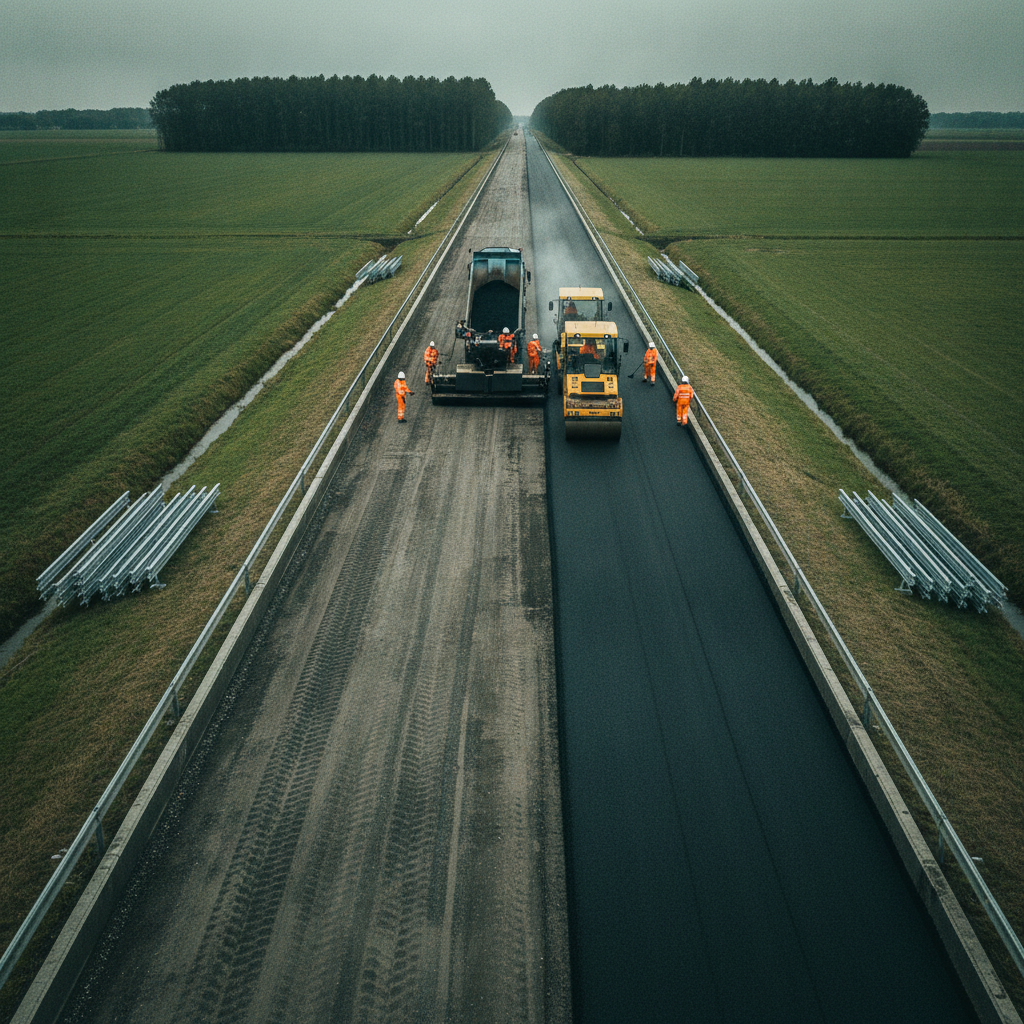

Four weeks fully closed, or four months partly closed. For the same work.
At five o’clock this morning the N48 between the Hoogeveen interchange and the N377 junction at Balkbrug closed, and it stays closed until the evening of Saturday 29 August. In those four weeks Rijkswaterstaat and contractor Gebr. Van der Lee will replace the asphalt, renew the crash barriers, widen the verges and rebuild the drainage. All of it at once, across the full width, inside a single closed window.
A week later the Westervoortse Brug between Arnhem and Westervoort closes to motorised traffic, from 10 August to 6 September, for concrete repairs, asphalt replacement and new expansion joint seals. Same principle: closed, done in one go, finished.
Both decisions are defensible. But they are decisions, and they are rarely presented as such. In the communication, the closure appears as a given that the surrounding area must adjust to. In reality it was preceded by a trade-off that determines who is affected, for how long, and how visibly.
Approach A: bundling into one window
The bundling model rests on a single principle: if you are taking the road out of service anyway, do everything you had planned for the coming years at the same time.
The N48 shows this clearly. Asphalt, crash barriers, verge widening and drainage are four distinct types of work with different crews and different plant. Executed separately, each would require its own traffic management, its own announcement and its own period of disruption. Bundled, they share a single closure.
The advantages are real and measurable. The total period during which the area notices anything is shorter. The work zone is safer, because road workers are not standing beside live traffic but on an empty carriageway. Delivery is cheaper, because traffic management is set up and dismantled only once and crews are not waiting on each other. And there is a single story to tell, with one start date and one end date.
The disadvantages lie in the distribution. A full closure has no gradations: there is no partly available route for those without an alternative. The disruption also relocates. Through traffic takes the diversion via the A28, N377 and N34, but part of it will look for the shortest way through the villages. Rijkswaterstaat has visibly anticipated this, with one-way systems, local-access-only rules, temporary entry bans and arrangements with navigation providers. In Nieuwleusen, traffic marshals are on duty at peak moments to guide cyclists, pedestrians and local traffic safely past the additional flow.
That last point is precisely the issue. The bundling model shifts part of the burden from the road user to the resident of the surrounding area, and that resident has no alternative route.
Approach B: spreading across smaller windows
The alternative is to break the work up: single-lane running, night closures, weekend windows, multiple seasons. The road stays available, if in worse condition.
For through traffic and for the surrounding villages that is more comfortable. No diversion pressure builds on the local road network, emergency services keep their normal approach routes, and businesses along the route stay accessible without anyone having to study a detailed map.
But the bill comes back elsewhere. The total duration becomes a multiple. The work costs more, because traffic management is rebuilt each time and crews are less productive in smaller windows. It is more dangerous for the people carrying it out. And it produces an effect the sector tends to underestimate: disruption fatigue. An area that notices something every week for six months experiences that cumulatively as heavier than four consecutive weeks, even when the measured delay per trip is lower.
At the Westervoortse Brug a variant of the spreading question is visible, but between asset owners rather than within one project. The municipality of Westervoort has deliberately scheduled its landscaping work on the Brugweg inside the same window, to avoid a second closure. That is spreading applied in reverse: not stretching the work out, but pulling the work of different parties towards each other.
Comparing on four criteria
| Criterion | Bundling (the N48 model) | Spreading |
|---|---|---|
| Total disruption period | Short and absolute: four weeks, then finished | Long and partial: months to seasons |
| Who carries the burden | Diverted traffic and above all nearby villages | Through traffic, spread across far more people |
| Cost and safety | Cheaper, safer work zone, higher productivity | More expensive, more risk to road workers, lower productivity |
| Predictability | High: one date, one message, a hard end | Low: repeated announcements, prone to slipping |
What stands out is that three of the four criteria favour bundling. That explains why it has become the dominant practice, and that is defensible in itself.
But the second criterion is not simply one of four. Bundling means a small, geographically concentrated group carries the full burden, while spreading gives a larger group a smaller one. That is not a technical trade-off but an allocation question, and allocation questions do not belong exclusively in a delivery schedule.
What this means for the trade-off process
Three things follow for how such decisions should be reached.
The choice belongs before the planning, not after it. In practice the bundling decision often emerges from the contract form and the work preparation, after which stakeholder management is asked to explain it. The reverse works better: first map who is affected under each variant, and let that weigh in the choice itself. On the N48 it is visible that this partly happened, because the measures against rat-running are too specific to have been an afterthought.
Compensate where the burden has been placed. If you deliberately choose short, intense disruption in a limited area, then the community in that area is not an audience for communication but a party that is contributing something. Traffic marshals on a school route, accessibility arrangements with businesses along the diversion and a point of contact that responds within a day are not a service in that case, but the consideration in return.
Be honest that the summer window is finite. Rijkswaterstaat itself speaks of the largest maintenance programme it has ever run, and the bundling model leans heavily on the one period each year when peak traffic is lighter. In August alone the N48, the N36 near Ommen and further away the Westervoortse Brug are all open in the same broad region. As the replacement and renovation programme grows, that window becomes overbooked and work shifts into periods where disruption weighs more heavily. That is no reason to plan differently now, but it is a reason to start the conversation now.
When each approach fits
Bundling fits when the diversion is a genuine alternative, when the local road network can absorb the displaced flow, and when there is a credible hard end date. Those are exactly the conditions on the N48: a parallel main road network in the A28 and N34, a period with less commuter traffic, and a closure bounded to the day.
Spreading fits when there is no reasonable alternative, when the diversion runs through vulnerable areas or past vulnerable functions, or when a full closure would halt an economic activity that cannot wait. A harvest season, a shipping window or a hospital access route outweighs delivery efficiency.
The mistake most often made is not the wrong choice, but the choice that was never consciously made: bundling because that is how it is done, without putting the allocation question on the table. Four weeks closed is defensible. That it was a decision, and which alternative was set aside, is something the community is entitled to know.
Sources
- Rijkswaterstaat: N48 between Hoogeveen and Balkbrug closed for four weeks in August 2026
- Rijkswaterstaat: major maintenance Westervoortse Brug, 10 August to 6 September 2026
- Rijkswaterstaat: summer 2026, additional traffic disruption from road works
- Rijkswaterstaat: major maintenance on roads and waterways