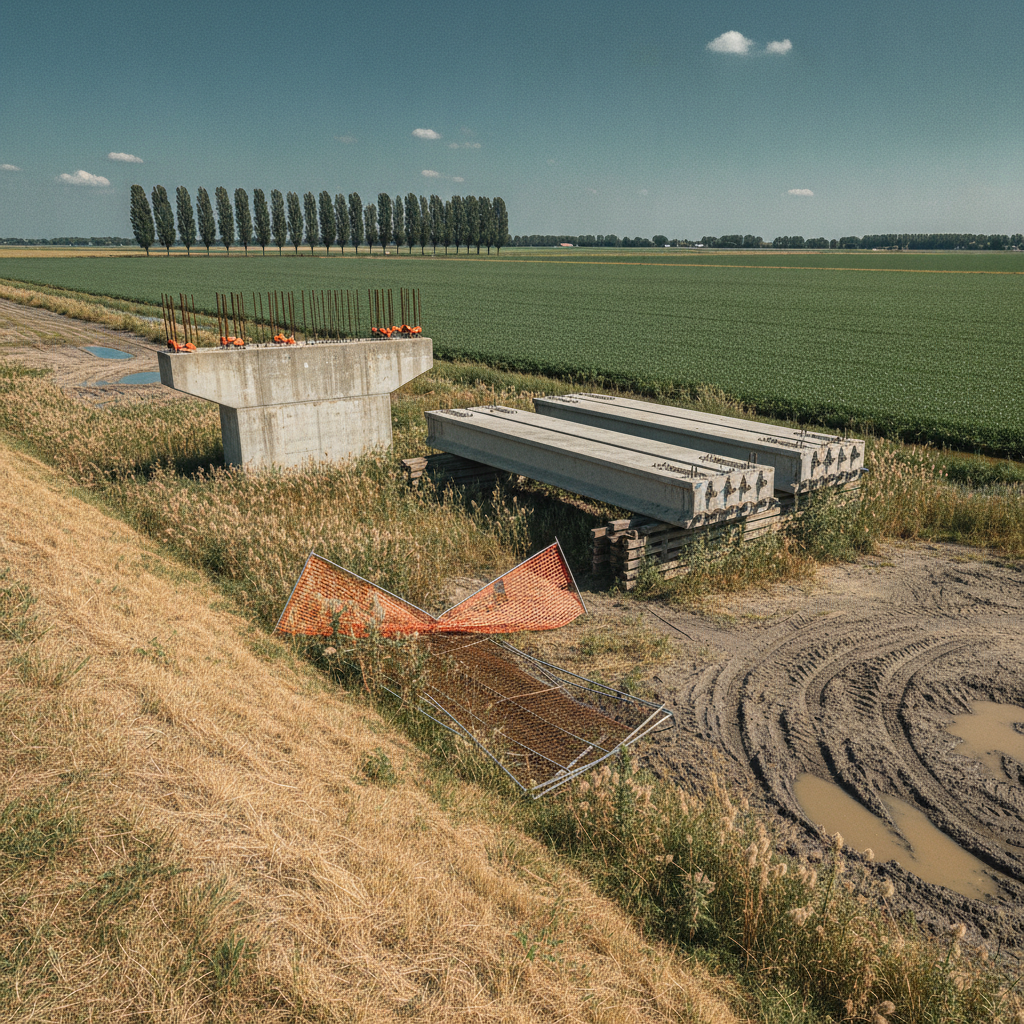
You have worked on a route alignment for four years. Three drop-in sessions a year, a sounding board group whose members now know each other’s birthdays, a noise barrier that grew two metres taller after long negotiation, and a handful of residents who postponed renovating because their property fell inside the acquisition strip. Then the decision lands: the project is going on the long finger. Who do you call first?
That question is about to become very concrete for a lot of project teams in the Netherlands. On Budget Day the government announced an additional 5.1 billion euros for the Mobility Fund through 2040, of which 1.5 billion is earmarked for major maintenance, plus 300 million a year for regional accessibility. The sentence that matters in practice sits in the same announcement: the task is large and the resources are limited, and billions are being shifted from new construction towards renewal and maintenance.
That shift acquires a face this autumn. Minister Karremans and State Secretary Bertram are reprioritising the entire national portfolio against criteria the cabinet set out in June: safety first, then keeping existing assets in service, and only then expansion. The guiding phrase is life extension where possible, renewal where necessary. The scale underneath is known: according to research institute EIB, the sixteen paused road projects and three waterway projects require 4.5 to 7 billion euros, replacement and renovation of bridges and tunnels through 2030 needs close to 13 billion of which roughly half is budgeted, and the maintenance backlog runs to 34.5 billion by 2038.
The first decisions are already visible. The Rijnenburg tram line, serving a Utrecht polder earmarked for more than 20,000 homes, will not be built: there is no room for new initiatives at present, the minister wrote. Even the 1.78 billion euros attached to the quashed Ring Utrecht route decision will not stay in the region but goes into the national reprioritisation.
For stakeholder and environmental management this is an awkward category of news. The discipline is built around explaining, integrating and defending a project that is going ahead. There is a handbook for participation, a methodology for disruption mitigation and a policy rule for compensation. There is no handbook for calling it off. Six steps for anyone who has to hold that conversation in the coming months.
1. Start by mapping what the community has already invested
Before you communicate anything, take stock of what has been promised, requested and adjusted over the years. Not as an accountability exercise, but as a working document. Think of commitments made (the barrier, the cycle link, the compensatory habitat), decisions others based on your project (a municipality that held back a local plan, a business that did not expand), and people who personally put something on hold.
This commitments file is the core of your message. Communities will accept a budget decision more readily than the feeling that four years of engagement have vanished without trace. Being able to name exactly what was gathered and where it now sits produces a very different conversation than forwarding the ministry’s letter.
2. Tell them yourself, in one round, before it appears in the papers
Budget documents and letters to parliament are public, and they get read. The worst version of this is a sounding board group learning from a regional newspaper that their project has been deferred, while the project organisation is still refining a careful communications approach.
So plan ahead of the decision moment rather than reacting to it. Know when the letter goes to parliament, and make sure the people you sat across from for four years hear it that same day, preferably by phone and from a familiar face. One round, not staged by perceived importance: anyone placed in the second round notices.
3. Be painfully precise about delay, pause and cancellation
This is where most of the damage occurs, and where the temptation to soften is strongest. Three situations that are constantly conflated in communications:
- Delay with a date. The project stays in the programme, the start decision stands, only the schedule moves. For the community this means continued uncertainty, but with a horizon.
- Pause without a date. The project is on hold until money, nitrogen headroom or delivery capacity becomes available. This is the position of the sixteen paused road projects. For residents this is the hardest variant, because there is nothing to plan around.
- Cancellation. The project is not coming back in this form. That is hard news, but it hands people back control of their own decisions.
State which of the three applies and which factual event could change the picture (a reprioritisation decision, a new programming round, a court ruling). Say explicitly what you do not know. “We expect to be able to say more about this late next year” is a usable sentence; “we remain committed to this project” is not.
4. Clear up what remains, legally and physically
A paused project leaves traces that do not disappear on their own. Work through them and assign an owner to each:
- Acquired land and properties. What happens to what has already been bought? Lease it back, sell it on, arrange interim management? Vacant buildings in a village are a visible reminder, for years, of a project that never came.
- Live acquisition negotiations. People in the middle of negotiations deserve clarity within weeks, not in the next newsletter.
- Reservations in local plans and zoning. A route reservation that stays in place while the project is cancelled ties up someone else’s development rights. This is exactly the kind of item that lingers because nobody owns it.
- Tolerance obligations and temporary works. Haul roads, monitoring equipment, vegetation that was cleared: decide whether these are reinstated or left, and say so.
5. Solve the disruption that does not disappear with the project
This is the step most often skipped. Many construction projects carried a second function: they would solve an existing problem along the way. The noise barrier sat inside the widening scheme. The dangerous crossing would disappear during the reconstruction. The ageing bridge would be taken along.
If the project does not proceed, that problem remains while the route to solving it falls away. Map those piggybacked items explicitly and hand them back to the asset management organisation or the road authority as standalone tasks. If you do not, the message to the community is effectively that they lose not only the project but also the fix for a problem they have been waiting on for twenty years. That is the moment trust collapses structurally.
This step grows in importance as the portfolio tilts towards asset renewal. A maintenance or renovation project has no area development in which to park added value; it has only the disruption of the works. Teams used to new construction will have to learn to negotiate with nothing to hand out.
6. Keep the file warm, even without a budget
Paused projects sometimes return. The earlier portfolio of paused national programme projects showed that a restart is expensive once local knowledge has evaporated: contacts have moved on, agreements were never recorded, the sounding board group has dispersed, and the relationship has to be bought back with time.
So arrange a minimal custodial phase. One reachable contact with a working email address. A recorded overview of commitments and their status. An annual update, even when the update is that there is no news. The cost of that is negligible against the cost of a cold restart.
Four pitfalls
“We will wait until there is more clarity.” Silence is also a message, and it is almost always interpreted more negatively than reality warrants. Communicate the decision that exists, including what is not yet known.
Skipping the local translation. A national reprioritisation against generic criteria is defensible at national level. At street level it is a concrete loss for a concrete group. Somebody has to make that translation, and it is not the ministry.
Letting commitments lapse in silence. A promise attached to the project may legally disappear with the project, but not in the community’s memory. State for each commitment whether it lapses, lands elsewhere or stands.
Cutting stakeholder management first. On a paused project the engagement team looks like the obvious line to cut. It is precisely the phase in which the organisation needs a face, and the phase in which the bill for removing it only arrives years later.
In closing
The decision to shift billions from construction to asset renewal is defensible and probably unavoidable. But it is not an accounting exercise. Behind every deferred project stands a group of people who were asked to think along for years, and who now receive an outcome they had no say in.
How that message is delivered will determine, for years, how much credit the next project organisation has in that same area. That makes calling off a project not a by-product of reprioritisation, but a task in its own right, deserving as much preparation as the start of one.
Sources
- Rijksoverheid - Budget Day 2026: extra money for infrastructure, but sharp choices remain necessary
- Rijksoverheid - Cabinet: the basis of our infrastructure must be in order
- OTAR - Cabinet presents criteria for investing in infrastructure
- RTV Utrecht - Minister has no money for tram to future residential district
- Binnenvaartkrant - Extra billions for infrastructure not enough: the task is much bigger