Zero point seven per cent. That is how much of last year the bridges and locks operated by Rijkswaterstaat, the Dutch national infrastructure agency, were unexpectedly unavailable to shipping, against an internal target of 0.2 per cent. Planned disruption from works also overshot: 1.1 per cent against a target of 0.8. Lock 13 in the Zuid-Willemsvaart canal was closed for more than a third of the year. Board member Louis Schouwstra told parliament that this has everything to do with the maintenance condition of the waterway network.
That figure is about steel, concrete and money. But it is just as much about software. A movable bridge that seizes up rarely fails in the deck itself; the problem sits in the drives, the sensors, the control system or the link to the remote operating centre. And that is precisely where the Netherlands has been reinventing the wheel object by object for decades.
From bespoke to modular
Rijkswaterstaat wants to put a stop to that. The agency is developing a Modular Technical Architecture (MTA) for the industrial automation of bridges, locks and tunnels: a set of reusable building blocks instead of a unique control system for every asset. The architecture draws on international standards from the ISA and IEC families, with IEC 62443 as the framework for the cybersecurity of industrial automation and control systems. Coordinating director Jack van de Velde describes the aim soberly: the MTA is a step towards manageable diversity.
Manageable diversity, not uniformity. The distinction matters, because a lock in a tidal estuary is simply a different animal from a lift bridge in a city centre.
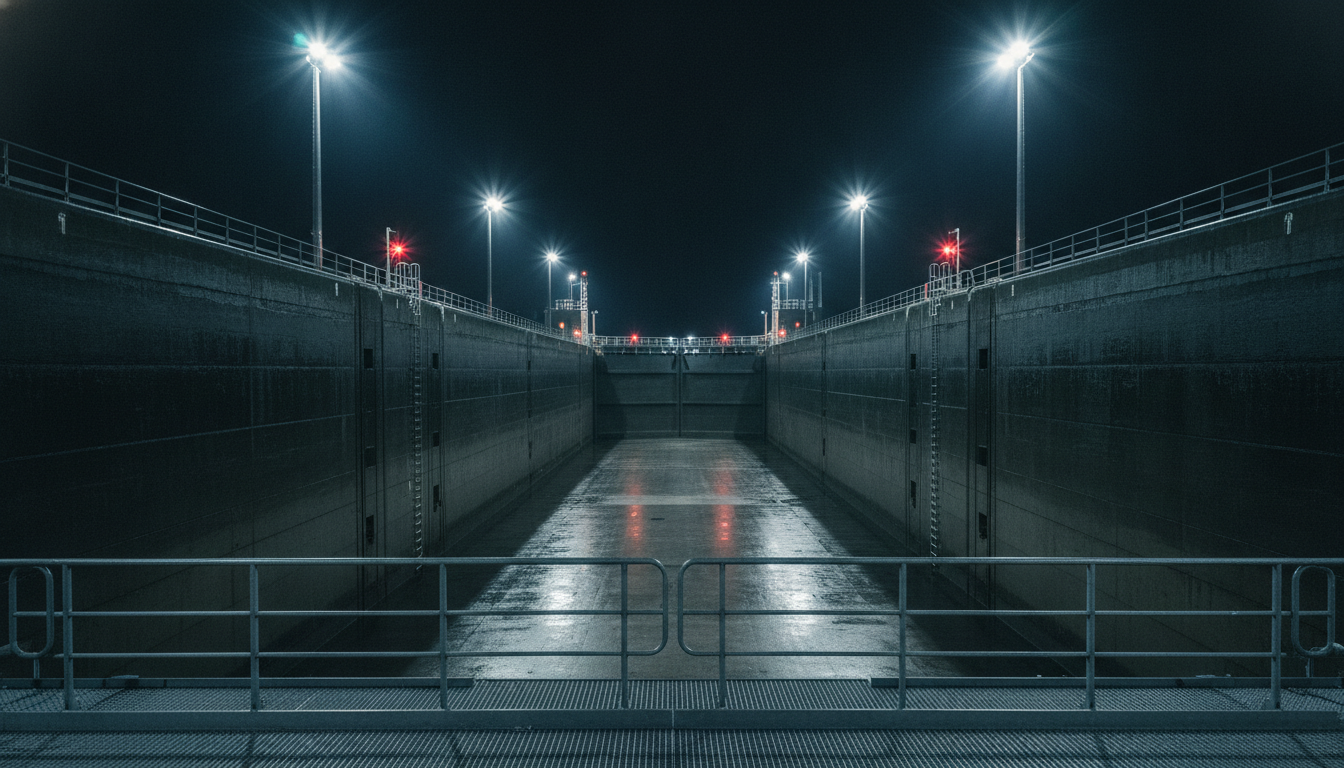
The first real testing ground is the Grevelingen lock. It forms part of a portfolio in which Rijkswaterstaat and the STROOOM consortium (BAM Infra Nederland, Equans and Demako) are renewing three locks in the province of Zeeland: alongside the Grevelingen lock, the Roompot lock and the Bergse Diep lock. The contract was signed in 2025 and work on the Grevelingen lock starts in 2027. It covers civil, mechanical and electrical engineering as well as industrial automation in a single commission. The modules tested there should then be reusable across hundreds of other operable assets.
For the technical community this is primarily an asset management story: faster fault resolution, knowledge carried from project to project, data comparable across assets and, ultimately, predictive maintenance. Rijkswaterstaat also stresses open standards and joint development with suppliers, to avoid vendor lock-in.
We see a second story in it, one that technical reporting rarely tells: standardising operation and control changes the relationship between an asset and the community around it.
The service is the operation, not the structure
To a skipper, a cyclist or a business owner on the quayside, a bridge is not a structure but a service. The question is not how the deck is suspended, but whether it will open, when, and how long the wait will be. The same holds for a lock. The product is a lockage at a reasonable moment, not the chamber.
That service is delivered by exactly the layer now being standardised. Every choice in the control system is therefore also a choice about the surrounding community. How many vessels does the system gather before the bridge opens? Does commercial shipping take precedence over recreational traffic? How long may a queue of cyclists build before the opening strategy switches? In bespoke systems such rules often sat implicitly in local agreements and in the operator’s head. In a modular architecture they become explicit settings. That is a gain for transparency, but it turns a once informal understanding into a parameter someone has to justify.
The point of contact moves
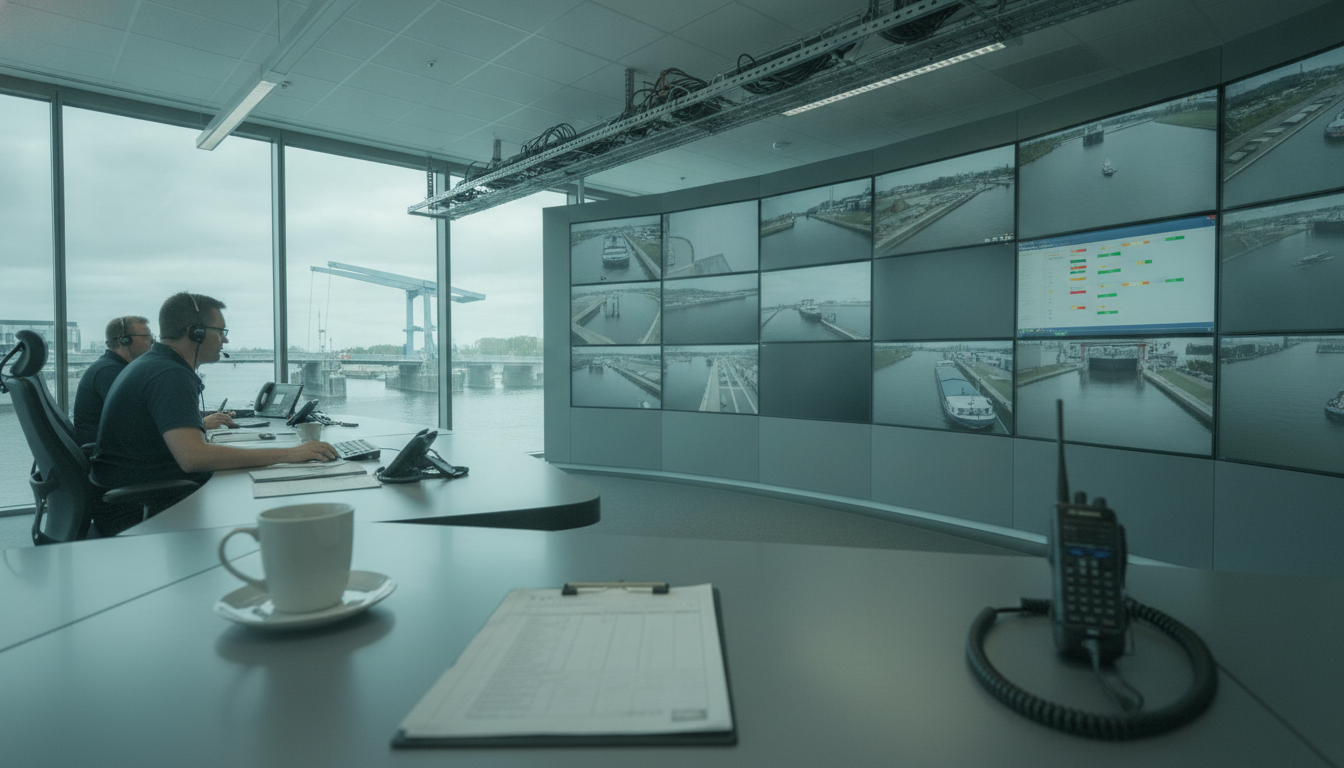
Remote operation reinforces that shift. The operating centre in Tilburg now controls a 110 kilometre corridor with 45 assets: bridges, locks and weirs. The benefits are real. An operator who can see several vessels approaching at once opens the bridge once instead of three times in quick succession. Cameras and sensors give a better view of pedestrians and cyclists than a glance from a bridge keeper’s cabin. And centralised operation makes extended operating hours possible, as on the Brabant canals.
The flip side is that the human face at the asset disappears. The bridge keeper who knew the regulars, who saw the ferry coming and who simply spoke to an angry neighbour, has been replaced by a phone number and a VHF channel. That is not an argument against remote operation, but it does mean the stakeholder function those people performed en masse has to be explicitly assigned somewhere else. And when staffing is tight, which Rijkswaterstaat itself cites as a cause of longer waiting times in busy periods, it is the operating centre that has to explain the bad news.
What standardisation does not standardise
Technology lends itself to modules; expectations do not. Every waterway region has arrangements that appear in no system design yet determine whether people are satisfied: the early lockage for the fishing fleet, the bridge that stays closed during school runs, the annual local event for which the operating regime is adjusted, the farmer who has to cross a movable bridge with a harvester.
In every renovation that replaces the control system, those arrangements either come back onto the table or quietly disappear. Our experience is that they usually disappear quietly, and that the complaint arrives a season later. An inventory of existing, often unwritten operating arrangements therefore belongs in the design file just as naturally as the load calculation for the deck.
Regional and local asset owners face the same choice
This is not a Rijkswaterstaat-only question. Provinces and municipalities together manage the majority of movable bridges in the Netherlands and are making the same move. The province of Overijssel is converting five bridges during the winter of 2026-2027, with an operating centre going live for the 2027 boating season. Cities with dozens of movable bridges are looking at the same prospect: one centre, more assets, fewer people on site.
Anyone taking that step has an interest in the national agency’s standards being usable for regional and local assets too. Otherwise a new kind of fragmentation appears: one national standard, a handful of provincial variants and as many municipal solutions, while the skipper on a single waterway sails through all of those regimes and the cyclist on a single route passes assets owned by three different authorities.
Disruption becomes serial too
Standardisation has a welcome side effect for the community. If three locks are renewed within one portfolio using the same building blocks, the disruption approach can become serial as well. What is learned at the Grevelingen lock about closure duration, diversion routes and communication with recreational boating is usable at the Roompot and Bergse Diep locks. That shortens the learning curve not only for the contractor, but for the stakeholder team.
There is a cost on the other side. Putting hundreds of assets on the same architecture also creates shared failure risk: a fault in a module or a security update can in principle affect several assets at once. That is technically manageable, but communicatively a different proposition from a fault at a single location. Regional failure of several bridges simultaneously calls for a crisis communication line that often does not yet exist, and for an asset owner able to explain why uniformity produces less downtime on balance.
Commissioning is a disruption phase
One last point that tends to stay invisible in planning: control software is not delivered, it is tuned. After the physical works comes a period of testing, adjustment and fault clearing in which the asset is formally in service but behaves erratically in practice. For users that is the phase with the worst experience and the least understanding, because the site fencing has gone and the operation still falters.
Building that phase into the stakeholder plan, and announcing it as such, prevents the first months of a modernised bridge from setting the tone for the years that follow. In a serial programme that counts double: experience at the first asset determines confidence in the next two.
Conclusion
The MTA is a sensible step in a task where too many assets are too old and there is too little money to renew them all at once. But the gain is only banked if the stakeholder side is part of the design. Three things therefore belong as standard in every renovation that replaces operation and control: an inventory of existing operating arrangements and who owns them, an explicit decision on the operating regime after handover including who will discuss it with users, and a fault communication line that reaches beyond a single asset.
Manageable diversity is a good starting point for technology. For the community, diversity is not a choice but a given: every bridge has its own village.
Sources
- Infrasite - Rijkswaterstaat moves away from bespoke control systems for bridges and locks
- Engineers Online - Standard industrial automation for bridges and locks
- Infrasite - Bridges and locks unexpectedly closed more often than Rijkswaterstaat wants
- Rijkswaterstaat - Remote operation of bridges and locks
- Rijkswaterstaat - Renewal of Zeeland locks awarded to STROOOM