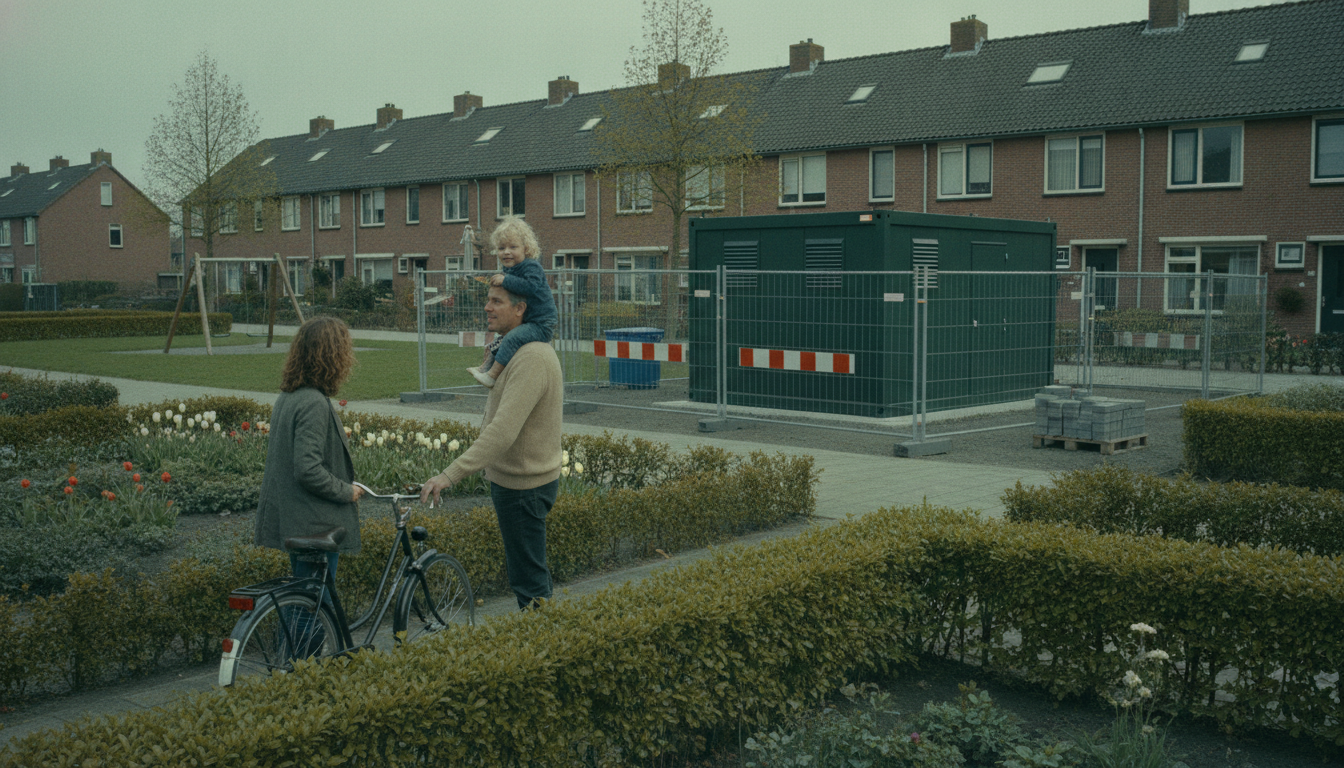

Crisis legislation will only speed up grid expansion if the community comes to the table earlier, not later. That is the core of our position on the package State Secretary Jo-Annes de Bat (Climate and Green Growth) sent to the Dutch House of Representatives on 11 September 2026. The direction is right and the urgency is real. But almost every measure in the package removes a formal moment at which residents, businesses or municipalities could previously make themselves heard. Do that without strengthening informal stakeholder work and you gain time on paper while losing it on site.
What the government is proposing
The government describes the package as ten decisions, aimed at halving the lead time for new grid connections. The measures that directly affect local communities:
- A single tier of appeal. From 1 October 2026, appeals against electricity projects of 21 kV and above go straight to the Administrative Jurisdiction Division of the Council of State. Pro forma notices of appeal are no longer allowed, and the Division must rule within six months of the defence being filed. The government expects savings of up to eighteen months in some cases.
- The province as default competent authority for new 110 and 150 kV projects, expected from July 2027. That should save anywhere from a few months to two years.
- Permit-free construction and extension of high and medium voltage substations, subject to limits on size and location. According to the government, this speeds up dozens of projects a year by a few months to eighteen months.
- No more EIA screening for underground high voltage cables; only overhead lines remain in scope. Saving: six weeks to three months.
- An exemption from nitrogen deposition permits for grid expansion, provided Brussels agrees.
- A separate fast-track regime for a small group of highly urgent projects, such as substations at strategic locations. Selection criteria are due this autumn.
The package also contains measures for smarter use of the grid, such as offering businesses access to the network’s emergency reserve capacity in exchange for curtailing their demand during outages. We leave those aside here.
Why we support the direction
Let us start with what is right. The queue is not an abstraction: thousands of businesses and housing projects are waiting for a connection, and since 1 July 2026 even small consumers can end up on a waiting list. A substation stuck in procedure for two years while four hundred homes wait for it is hard to justify to anyone. Scrapping pro forma appeals and setting a deadline for rulings are defensible interventions; the Crisis and Recovery Act did similar things in 2010, and part of that has since become standard administrative procedure.
Netbeheer Nederland, the association of Dutch grid operators, welcomed the package, with director Hans-Peter Oskam rightly noting that success is measured by the number of homes and businesses that come off the waiting list, not by the number of bills tabled.
Where it chafes: every step removed was also a signal
A formal comment, an objection, an EIA screening: they are procedural steps, but they are also the moments at which a developer learns what it overlooked. The hum of a transformer next to a playground. The only access road to a farm, cut by a cable route for months. The archaeological zone nobody had on the map.
Take permit-free extension of medium voltage substations. For the grid operator it is a sensible simplification of routine work. For the neighbour it means a larger building appears without notice, without publication, without a deadline and without an address to write to. Permit-free does not mean rule-free, but it does mean notice-free. We know plenty of cases where exactly these small objects, the substation kiosk on the village green, the cabinet on the pavement, generated the angriest phone calls.
The same applies to a single tier of appeal. That is fine, provided the decision-making beforehand is so sound that little needs repairing. This summer, in the WarmtelinQ heat pipeline case, the Council of State showed that a carefully reasoned assessment of alternatives holds up. When there is only one court, there is no second chance to fix a flaw that a district court might have flagged earlier. Diligence has to move upstream.
The nitrogen exemption: do not count on it
On one element we are explicitly sceptical. The exemption from nitrogen permits depends on agreement in Brussels. In November 2022 the Council of State struck down the construction exemption in its Porthos ruling because it could not be reconciled with the Habitats Directive. A project team that bases its schedule today on an exemption that does not yet exist risks an annulled decision that costs more time than the exemption could ever have saved. Our advice to grid operators: keep building the nitrogen case until a legally robust scheme is actually in place.
The counterarguments
“The community is what slows things down, so less consultation is a gain.” Only partly true. A large share of lead time sits in the capacity of grid operators and competent authorities, in materials, in technicians and in project preparation itself. And where communities do cause delay, it is usually because they were involved too late or too little. Removing an objection step does not prevent an angry resident; it only changes where they turn up: at the alderman’s office, in the press, or at the site fence.
“Participation takes time too, and we do not have it.” Well organised stakeholder work runs in parallel with design and preparation. It costs money and people, not months on the critical path. A procedure that stalls on an unforeseen interest does cost those months.
“These are small substations, nobody loses sleep over them.” Residents do not judge an object by its voltage level but by its distance from their bedroom window. The smallest objects are the ones closest to people.
“The province becomes the competent authority, so coordination is sorted.” Formally, yes. But residents will keep knocking on their municipality’s door; the municipality loses its formal role but keeps its front desk. Without agreements between province, municipality and grid operator about who tells whom what, you get exactly the confusion the government is trying to resolve.
What is needed alongside the crisis act
We are not arguing for less acceleration, but for a compensating stakeholder track. Specifically:
- Grid operators adopt their own information standard for permit-free projects. A letter to neighbours well before work starts, a named contact with a phone number, and design rules for noise, greenery and appearance that carry as much weight as a permit condition. Netbeheer Nederland is the obvious party to set that standard across the sector.
- Provinces build stakeholder capacity, not just legal capacity. Authority over 110 and 150 kV projects without people who know the areas and can hold the conversations will produce slow and poorly reasoned decisions. With only one tier of appeal, that is a real risk.
- The fast-track regime gets participation requirements written into the act itself. If procedural steps are dropped for the most urgent projects, require a stakeholder analysis and a participation report to accompany the decision, and publish the selection criteria. The question “why here and not there” will come regardless; better to have the answer ready.
- Measure the effect. Track how many projects still suffer delays from local factors after the act takes effect. In two years we will then know whether the gain was real.
In closing
On 25 November the House of Representatives debates grid congestion. We hope the debate is not only about how much procedure can be cut, but also about what replaces it. The crisis act removes consultation steps. The conversation with the community is still needed; it simply moves to the front. Grid operators and provinces that organise that now will genuinely go faster. Those who think the law does that work for them will find that the delay simply arrives later, and then without a court to resolve it within six months.
Sources
- Wieringa Advocaten - Crisiswetgeving voor netcongestie in de maak!
- Binnenlands Bestuur - Een crisis- en herstelwet voor netcongestie komt er nu aan
- Maakindustrie - Kabinet zet crisiswetgeving in om netcongestie sneller aan te pakken
- Energienieuws - Kabinet zet nieuwe crisiswetgeving in om vol stroomnet aan te pakken
- VEMW - Verbreding discussie netcongestie: welk probleem proberen we op te lossen?
- Tweede Kamer - Brief regering: Aanpak netcongestie