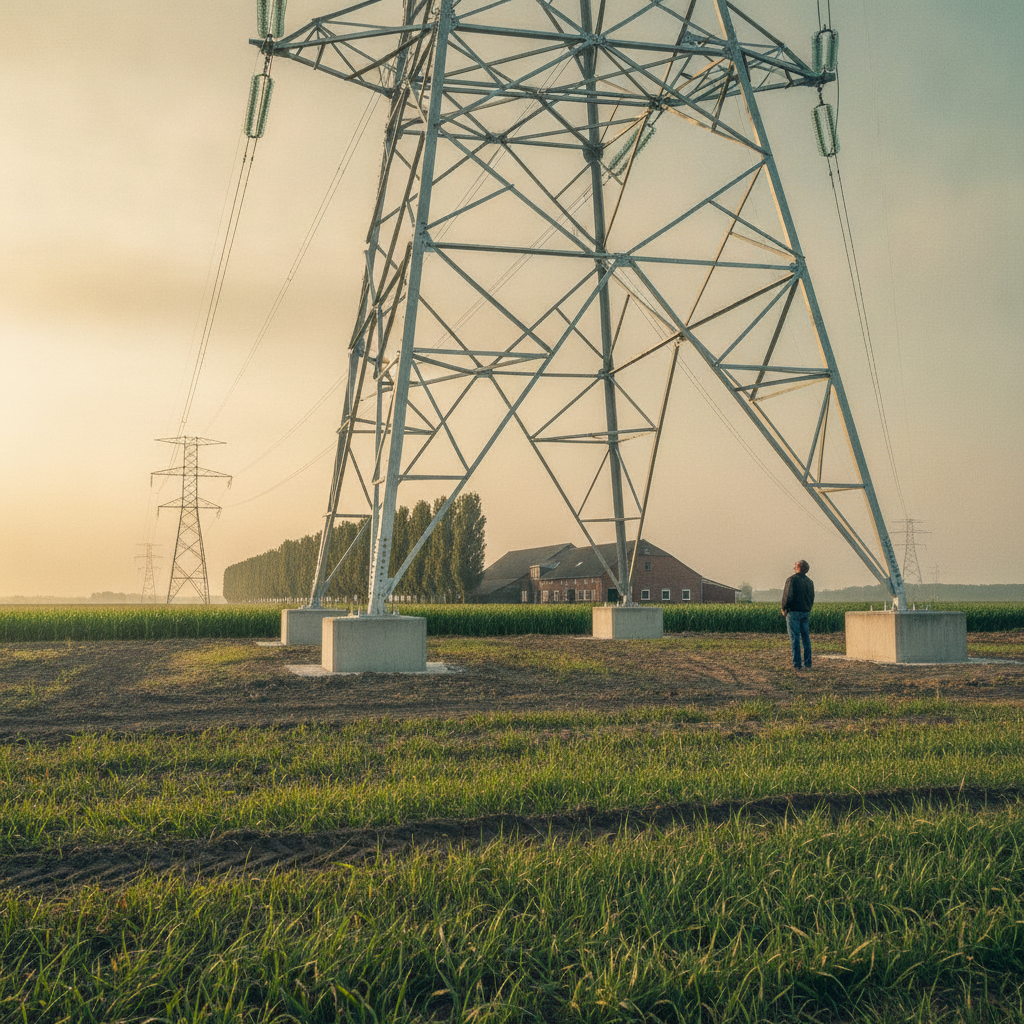

On Monday 14 September the first machines moved onto West Flemish farmland for Ventilus, the 82 kilometre transmission connection between Zeebrugge and Avelgem that is meant to carry North Sea offshore wind power inland. At that same moment forty appeals against the environmental permit were pending before the Flemish Council for Permit Disputes, seven municipal authorities were challenging the project, and the Belgian Council of State had a hearing scheduled on the underlying regional spatial plan. Work went ahead anyway, because an appeal does not suspend the permit.
Two hundred kilometres north, the same task is playing out. TenneT is developing the 380 kV Vierverlaten-Ens connection, which has to reinforce the grid in the northern Netherlands, partly for offshore wind. There, what lay open for inspection this summer was not a construction site but a draft preferred decision, from 22 May to 2 July. The preferred decision becomes final this quarter, impact studies run through 2027, the draft project decision goes out for inspection in 2028, and the project decision itself is scheduled for 2029. Construction comes after that.
Two countries, the same engineering problem, the same kind of resistance, and a fundamentally different answer to the question of when you make a decision final. For stakeholder and environmental management professionals that contrast is instructive, precisely because neither route is obviously better.
The Flemish route: decide, permit, build, and litigate afterwards
Ventilus has been dragging on for years. The core of the conflict was never whether the connection is needed, but how to build it. Residents and local authorities wanted an underground direct current line. An international expert panel concluded that this was not technologically feasible for this connection, and that underground alternating current is possible for at most eight to twelve kilometres. When that advice failed to produce consensus within the Flemish government, an intendant was appointed to mediate between citizen platforms, municipalities and Elia. The result is a route that runs largely overhead, with a limited underground section.
From there it moved quickly. A fresh public consultation ran from 6 February to 7 March 2026. At the end of April, Flemish environment minister Jo Brouns granted the environmental permits. In July it emerged that forty appeals had been filed, some of them also seeking suspension. And on 14 September Elia started regardless: first with reinforcement of the existing line and works spread across the whole corridor, while the underground cables and the new overhead line along the E403 motorway do not begin until spring 2027. The mayors of Ardooie, Lendelede, Ledegem, Roeselare, Harelbeke, Deerlijk and Wingene read that sequence as a strategy: start with what is least contested and wait for the rulings on the rest. Commissioning is planned for 2030 or 2031.
The Dutch route: explore at length, decide late
Vierverlaten-Ens follows the project procedure of the Environment and Planning Act, with the central government coordination that applies to connections of this kind. That means an exploratory phase with alternatives, a draft preferred decision open to formal views, a final preferred decision, then impact research at route level, then a draft project decision open to formal views again, and finally a project decision that can be appealed in a single instance to the Administrative Jurisdiction Division of the Council of State. The chosen preferred alternative broadly follows the existing 220 kV route, which narrows the debate without removing it: near Leeuwarden it runs close to the Zuiderburen and Hempens-Teerns neighbourhoods, and opposition there is real.
The price of that route is time. Between the moment the need is established and the moment an unappealable decision exists, eight to ten years pass easily in the Netherlands. The return is that the decision which eventually lands usually holds up, and that the affected community has had two formal turns before the first pylon goes in.
Four criteria
| Criterion | Flanders (Ventilus) | Netherlands (Vierverlaten-Ens) |
|---|---|---|
| When certainty arrives | Permit 2026, construction 2026, court ruling afterwards | Project decision 2029, appeal after that, construction only once it holds |
| Technology choice | Expert advice plus political mediation through an intendant | Alternatives weighed inside the EIA and the preferred decision |
| Health | Binding standards in VLAREM since 2022 | Non-binding precautionary policy, revised in 2023 |
| Compensation | Buyout perimeter 100 m, EUR 70 to 100 million, paid after completion | Purchase policy 100 m since 1 January 2026, market value offer up front |
1. Speed against durability. Flanders gains years by building while procedures run, but buys a risk in the process: if the Council for Permit Disputes annuls part of the permit, steel is already standing in the fields. The Netherlands buys certainty by investigating everything in advance, and pays for it with a lead time in which the energy task itself changes again. Anyone with the annulment of the Ring Utrecht route decision still fresh in mind knows the Dutch route is no guarantee either.
2. Who decides on the technology. This is the sharpest difference. In Flanders the direct current question became a political file that was only settled through an expert panel and subsequently an intendant. In the Netherlands that trade-off sits inside the formal track, in the comparison of alternatives within the environmental impact assessment. It is less dramatic, but it avoids a parallel negotiation in which the project organisation loses out the moment political leaders commit to a position personally.
3. Standard against precaution. In 2022 Flanders anchored a binding limit of 100 microtesla for new and modified connections in its VLAREM environmental regulations, plus an assessment framework aimed at avoiding sustained exposure above 0.4 microtesla. The Netherlands works with a policy advisory instead: the revised precautionary policy in force since 1 October 2023, in which the magnetic field zone is the strip where the annual average field can exceed 0.4 microtesla, now covering underground cables, substations and transformer housings as well, and with sensitive locations no longer defined around children alone. A standard is easier to explain at a kitchen table than an advisory. But a standard you meet also closes the conversation, while Ventilus shows that the concern does not disappear the moment the meter stays below the threshold.
4. When the money arrives. Both countries now apply a hundred metre buyout zone. Flanders widened its perimeter from 35 to 100 metres in an agreement between Elia and then energy minister Zuhal Demir, with a package Elia estimates at EUR 70 to 100 million. The Dutch purchase policy has applied since 1 January 2026 to homes within a hundred metres of the centreline of a new overhead connection: staying or selling at market value is the resident’s own choice, and tenants receive a relocation allowance. The difference lies in the timing. According to Flemish broadcaster VRT NWS, Elia only pays out once the works are complete, which for residents can mean staying five years or more in a house they want to leave. Some have already moved at their own expense. That is exactly the scenario in which a scheme that is generous on paper works against you in practice.
What a Dutch practitioner should take from this
It is tempting to conclude from Ventilus that the Netherlands should dare to move faster. That conclusion is too simple. What the Flemish file mainly shows is that speed in decision-making backfires as soon as the accompanying measures lag behind the construction pace. The permit is in place, the machines are rolling, and the compensation is still a promise. That is the order in which trust collapses.
Three things transfer. First, settle the technology debate early and definitively, with independent substantiation that survives a change of political leadership. An expert panel brought in only after the conflict has escalated arrives four years late. Second, decouple the buyout scheme from the construction programme. A resident who has to wait for completion before seeing the money experiences the scheme not as compensation but as added dependency. For Vierverlaten-Ens that is a concrete design question for the coming years, not something for 2029. Third, do not underestimate how much calm an explicit standard provides, even where it changes little in substance. Dutch precautionary policy is more careful than its reputation suggests, but in a village hall the word advisory does more damage than the content warrants.
Both countries are up against the same wall: a grid reinforcement that is technically unavoidable, in a landscape where everyone already lives. The question is not which route is faster, but which route ends with a connection that stands and a community that can still recount how the decision was made.
Sources
- VRT NWS - Ventilus works begin, some residents have already left
- VRT NWS - Forty appeals filed against the Ventilus environmental permit
- VRT NWS - Ventilus permits granted, reactions from mayors
- Elia - Ventilus
- RVO - 380 kV Vierverlaten-Ens transmission connection
- TenneT - Vierverlaten-Ens 380 kV
- RIVM - Revised precautionary policy on magnetic fields
- IPLO - Spatial integration of high-voltage connections and magnetic fields