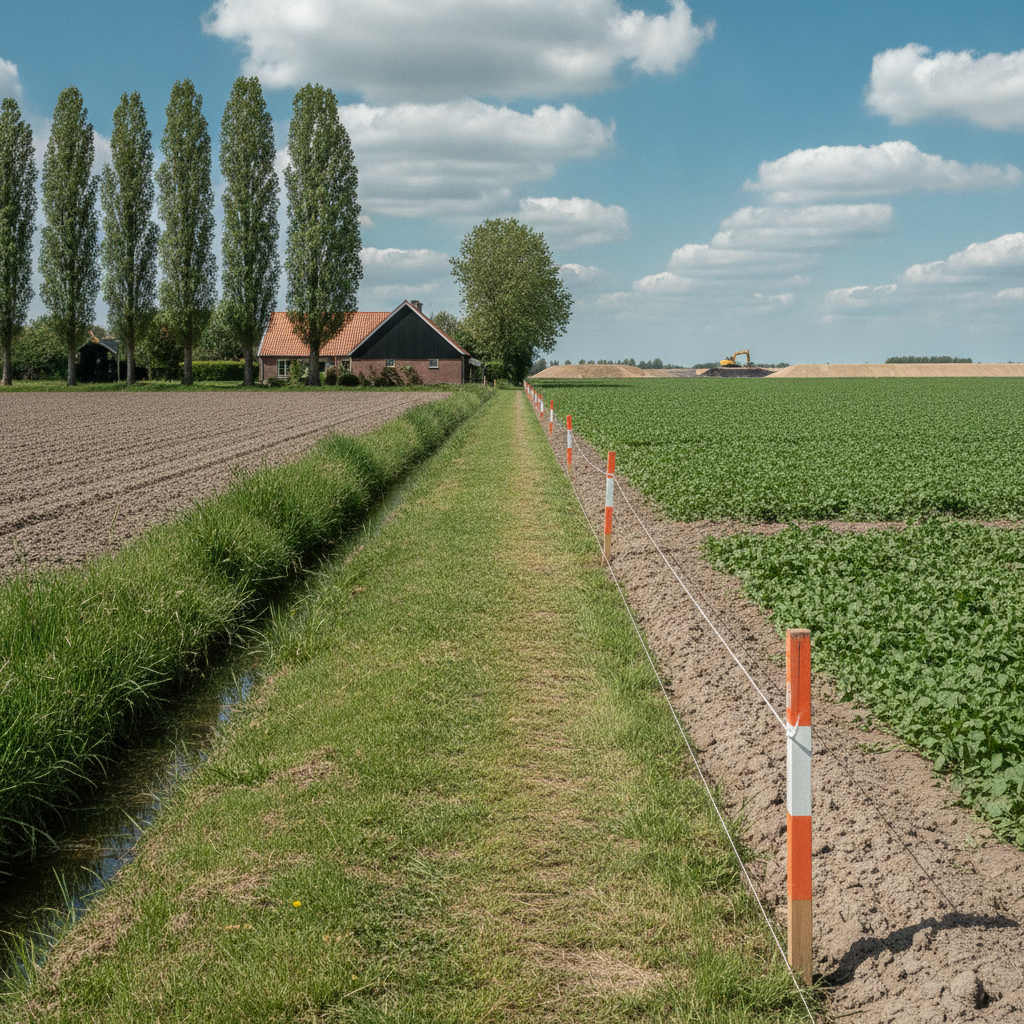

Building a bypass around Klundert, a town of just over six thousand residents in the municipality of Moerdijk, required land held by three separate owners. The municipality eventually reached agreement with two of them: with the first shortly before the case came before the district court in August 2025, with the second in January 2026. The third owner remained. That single outstanding case has now produced two rulings from the Administrative Jurisdiction Division of the Dutch Council of State, on 4 February and 8 July 2026.
That may seem like a great deal of litigation over a few hectares of farmland along a regional road. But this is the first case to travel the entire new expropriation chain under the Environment Act, from decision to appeal. What the Division decides here will apply just as much to a 380 kV transmission route, a flood defence upgrade or a lock refurbishment.
A systemic change that is only now becoming visible
Since the Environment Act came into force on 1 January 2024, expropriation works fundamentally differently. Previously the civil court pronounced the expropriation, following a Royal Decree. Now the public authority itself issues the expropriation decision: the municipal council, the provincial executive or the relevant minister.
What follows is an instrument Dutch administrative law had not seen before: the confirmation procedure. Its core principle is that the expropriation decision has no effect until the administrative court has confirmed it. The authority must request that confirmation itself, within six weeks of the decision being published for inspection. Interested parties can lodge objections during that period. The district court hears the case, with a statutory handling period of six months per instance, and its judgment can be appealed to the Division. Compensation runs along a separate track before the civil court.
For stakeholder and environmental management professionals, the shift matters more than the procedural mechanics. Expropriation is no longer a closing item you hand off to a land acquisition specialist and a lawyer. It has become an administrative decision that forms an integral part of the same decision-making process that produces the environment plan, the project decision and the permits. And it is assessed by the same administrative court, against the same standards of due care and reasoning.
What the Klundert rulings actually decided
The first ruling, of 4 February 2026, addressed a structural question. The district court had held that in this case only the tenancy right could be expropriated. The Division corrected that: the Environment Act provides no such option. What is expropriated is the immovable property itself, and through the title-clearing effect all rights and encumbrances attached to it lapse, including agricultural tenancies and easements.
This is not merely a legal nicety. It means the tenant or user is an independent interested party who must be engaged separately during the negotiation phase, even where agreement with the owner was reached long ago. In the agricultural areas where most linear infrastructure lands, that split between ownership and use is the rule rather than the exception.
The second ruling, of 8 July 2026, bears even more directly on day-to-day practice. Two points stand out.
The first concerns the acquisition file, the log in which the authority records how negotiations proceeded. The Division held that this log need not be published in full during the draft stage. Article 7.6 of the Environment Decree contains an exhaustive list of documents that must be made available for inspection, and the log is not among them. That removes a genuine concern, since such files contain commercial and personal data belonging to third parties that cannot simply be released into a public procedure.
Anyone concluding that the file therefore matters less has misread the ruling. The contents of that log are precisely what the court uses to judge whether negotiations were conducted in good faith. It does not have to be public, but it does have to exist, and it has to be able to carry the story.
The second point concerns compensation in kind. Where an owner states that they want replacement land rather than money, the authority must genuinely explore that option. But the Division sets a limit: there is no obligation to approach estate agents in search of exchange land, certainly not where concrete offers have already been made. Monetary compensation remains the statutory default. And, at the heart of the ruling: the fact that negotiations did not produce the outcome the owner wanted does not mean they were conducted without sufficient seriousness.
Effort is judged, outcome is not
A standard is emerging here that closely resembles what the administrative court is currently developing on participation. In both cases the form is largely free, the outcome is not prescribed, and yet the process is assessed on whether it was serious. The test lies in the file, not in the consent.
For land acquisition that is both a reassuring and an uncomfortable message. Reassuring, because a single reluctant owner cannot block a project simply by rejecting every offer. Uncomfortable, because the quality of your conversations, your accessibility, your response times and your willingness to weigh alternatives seriously are now all part of a file a judge will read.
The urgency test also works in practical terms. In this case urgency was sufficiently substantiated because preparatory works begin in mid-2027 and construction no later than early 2028. An authority expropriating for a project still waiting years for funding will not clear that bar. Land acquisition and project planning therefore have to be aligned, and that is precisely one of the pressure points in the Dutch asset renewal programme.
The other side: the statutory duty to tolerate
Alongside the expropriation track, a second development has affected landowners since 1 January 2026. The Environment Act now includes a standard duty to tolerate preparatory works. Landowners are obliged to cooperate with surveys, soil investigations, the placing of markers, exploratory excavation and ecological or archaeological fieldwork such as hand borings, cone penetration tests and monitoring wells.
The regime covers the electricity grid, the national hydrogen network, heat infrastructure, wind farms and mining activities, among others. The initiating party must inform the owner or user in writing at least four days in advance; only then does the duty apply. The time saved is estimated at several months up to a maximum of eighteen months per project, because refusals no longer trigger separate proceedings.
For grid operators surveying hundreds of kilometres of route, that is a real gain. But it shifts something. Where first contact with a landowner used to be a request, it is now a notification. Four days’ written notice is legally sufficient and relationally thin. Those who use the duty as it was intended, as a backstop when discussion fails, keep the relationship intact. Those who use it as a starting point begin a process that may later end in expropriation with an announcement rather than a conversation. That choice is made during fieldwork, years before any decision is drafted.
What this means for the programme ahead
The next fifteen years will demand an unprecedented amount of land. New transmission lines and converter stations, offshore wind landfalls, the hydrogen network, heat networks, flood defence upgrades along rivers and lakes, relocations tied to bridge and lock replacement. Almost all of these interventions land in areas where the ground already has an owner and usually a user as well.
Three conclusions follow from the first case law.
The negotiation phase is not a preliminary but the evidence. Record from the first conversation onwards what was offered, what was asked, what was investigated and why an option was ruled out. Not because it becomes public, but because it is the foundation on which confirmation stands or falls.
Treat ownership and use as two stakeholders. The title-clearing effect makes the tenant legally less visible and factually no less affected. In agricultural areas that distinction is the difference between a supported process and a court case.
And align land strategy with project planning rather than the reverse. Urgency must be demonstrable, and an expropriation launched too early because the process takes so long will fail on exactly that point.
Land acquisition was long treated as a technical and legal discipline sitting alongside stakeholder and environmental management. Under the Environment Act that distinction no longer holds. The court is looking at the same thing: were the people affected treated with due care, and can you show it.
Sources
- Dirkzwager: Council of State clarifies expropriation under the Environment Act
- Nysingh: expropriation under the Environment Act, second confirmation ruling
- Informatiepunt Leefomgeving: first appeal ruling on an expropriation decision
- Rechtspraak.nl: confirmation procedure for expropriation under the Environment Act
- Solar Magazine: landowners now required to cooperate with grid operator surveys
- Municipality of Moerdijk: Randweg Klundert project